

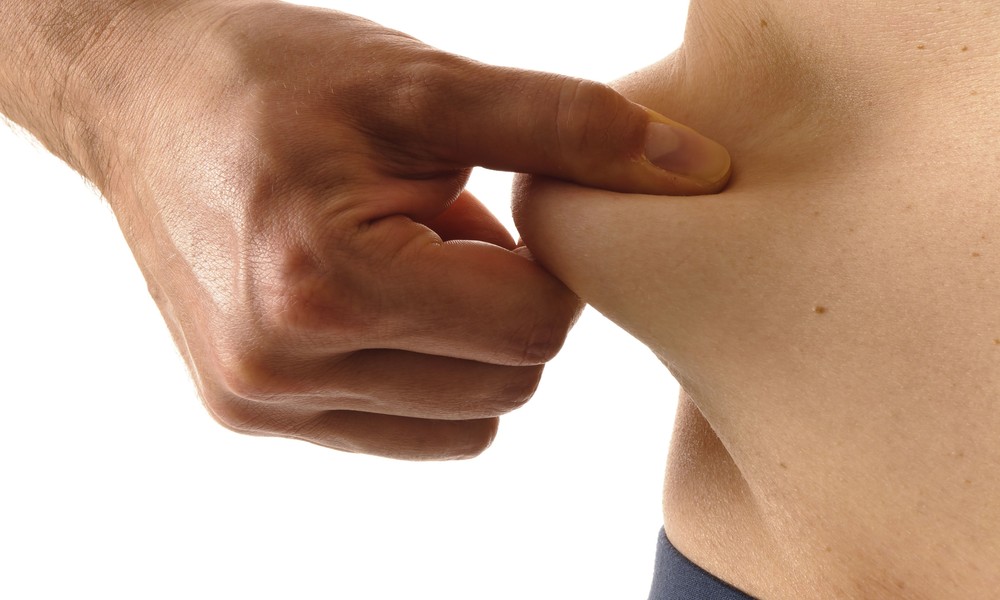
Love handles are the last place men lose fat because the hip and flank region has the highest alpha-2 receptor density in the male body, making it biologically resistant to the same fat-release signals that work everywhere else. This isn’t a personal failing – it’s male endocrine biology protecting your primary energy reserve.
The complete explanation of why love handles resist conventional fat loss – and what the hormonal approach looks like that actually targets them – is covered in this why love handles won’t go away guide, which explains the receptor and hormonal biology in full.
The Fat Distribution Sequence Is Not Random
When the body mobilises fat in response to a caloric deficit or exercise-driven catecholamine release, it doesn’t pull from all fat stores equally. The sequence in which fat is mobilised follows the receptor distribution map of the body – specifically, the ratio of beta-adrenergic receptors (which promote fat release) to alpha-2 adrenergic receptors (which inhibit it) in each region.
Regions with high beta-to-alpha ratios respond first. Regions with high alpha-to-beta ratios respond last. The face, upper torso, and arms are beta-dominant. The love handles, hip region, and lower abdomen are alpha-2 dominant. This is a consistent feature of male fat cell biology, not a personal quirk of individual fat distribution.
To understand why this matters mechanistically: when you exercise or create a caloric deficit, your sympathetic nervous system releases norepinephrine and epinephrine (catecholamines). These hormones bind to adrenergic receptors on fat cells to initiate the lipolytic cascade – the process of breaking down triglycerides into free fatty acids that can be burned for fuel. But in alpha-2 dominant tissue like love handles, norepinephrine binding to alpha-2 receptors actually suppresses this process rather than activating it. The same hormonal signal that triggers fat loss elsewhere becomes a brake on fat mobilization in these protected deposits.
The Male-Specific Pattern
The alpha-2 receptor dominance in the love handle region is more pronounced in men than in women, though women have the same pattern in their hip and thigh regions. Men store fat preferentially in the abdominal and flank area (android fat distribution) while women tend toward gluteal-femoral storage (gynoid distribution). In both cases, the preferred storage site is an alpha-2 dominant region – the biology consistently protects the primary sex-specific fat depot.
This pattern isn’t accidental. From an evolutionary perspective, the body preferentially protects reserves in the region most essential for survival and reproductive success within each sex. In males, abdominal and flank fat deposition is associated with sex hormone patterns – particularly androgen profiles – that directly influence where fat gets stored and how resistant that fat becomes to mobilization. The presence and sensitivity of alpha-2 receptors in these regions appears to be androgen-regulated, making the stubborn nature of love handle fat a feature of male endocrine biology specifically.
This means love handles in men aren’t just “stubborn” in the colloquial sense – they’re biologically protected fat stores that the body preferentially retains and reluctantly releases. Fighting this biology with willpower alone, or with a standard approach that works well for other body areas, is fighting the endocrine system directly.
What Standard Fat Loss Approaches Miss
A caloric deficit creates the energy condition for fat loss. It’s necessary but insufficient for love handle fat specifically. The deficit elevates catecholamine levels and creates a situation where fat release should increase – but in alpha-2 dominant tissue, the catecholamine signal hits inhibitory receptors that block the fat release pathway rather than activating it.
The result is that a standard caloric deficit drives fat loss efficiently from beta-dominant regions and very slowly from alpha-2 dominant regions like the love handles. More calories cut doesn’t solve the receptor problem. More cardio doesn’t solve the receptor problem. The approach needs to address the receptor environment, not just the energy balance.
Many men run into a plateau precisely because they’re relying on strategies that work well until they stop working – which is exactly when they reach the alpha-2 dominant tissue. A 500-calorie daily deficit might produce rapid upper-body fat loss, but that same deficit applied month after month produces minimal love handle reduction. The frustration people feel isn’t a sign of personal failure; it’s a sign that the approach is mechanistically mismatched to the tissue they’re trying to change.
The Role of Cortisol
Cortisol – the stress hormone – has a specific relationship with abdominal and flank fat storage. Chronically elevated cortisol promotes fat storage in the visceral and subcutaneous abdominal and flank regions, partly through glucocorticoid receptor activity in these fat cells. Cortisol also increases insulin resistance, driving more glucose and amino acids into adipocytes in these regions, and it directly impairs hormone-sensitive lipase function – the enzyme required for fat mobilization.
This creates a cortisol-specific love handle mechanism: stress, sleep deprivation, overtraining, and caloric restriction taken too far all elevate cortisol, which actively drives fat into the love handle region. People who try to address their love handles by drastically cutting calories and adding large amounts of cardio often inadvertently drive cortisol up – which works against love handle fat loss specifically even while producing general fat loss. They get leaner everywhere except where they most want to lean out, because the stress-hormone environment is actively antagonistic to that specific goal.
The Protocol That Addresses the Biology
Manage Cortisol Actively
Keeping cortisol in check means moderating caloric deficit severity, managing training volume, protecting sleep, and avoiding chronic psychological stress where possible. This is not optional for love handle fat loss – elevated cortisol is actively antagonistic to the goal. Practically, this means a 300-400 calorie daily deficit rather than an aggressive 700-calorie one, even if it means a longer timeline. It means sleep is not negotiable; cortisol dysregulation from chronic sleep debt specifically promotes abdominal and flank fat storage. It means training intensity and intelligent volume, not high volume across the board.
Target Insulin Strategically
Insulin suppresses hormone-sensitive lipase – the enzyme that executes fat release after the catecholamine signal. Creating consistent windows of low insulin makes the fat cells in the love handle region less doubly-blocked. Time-restricted eating and strategic carbohydrate timing are practical implementations. Placing carbohydrates around training windows, when insulin sensitivity is highest and the catecholamine signal is strongest, allows energy to be used productively while keeping fasting periods where insulin is lower and lipolysis is unblocked. This creates a hormonal environment where the love handle region is more accessible to fat mobilization than a constant-feeding pattern would allow.
Use Intensity, Not Volume
The catecholamine surge required to overcome alpha-2 receptor resistance requires training intensity – not just training volume. High-intensity resistance training and sprint intervals produce the catecholamine output needed to penetrate the alpha-2 braking effect in ways that steady-state moderate-intensity training does not. A 20-minute high-intensity session creates a more favorable hormonal environment for love handle mobilization than 60 minutes of moderate-pace cardio, because the intensity drives the neuroendocrine response that’s mechanistically required. This doesn’t mean high intensity for every session, but it does mean that at least some training must produce genuine sympathetic nervous system activation.
The Timeline Reality
Love handles will always be among the last body areas to clear. A man starting at 22% body fat may not see significant love handle reduction until he reaches 14-16% – well after the upper body and face have transformed. This isn’t failure; it’s the receptor biology doing exactly what it’s designed to do. The goal is to ensure that the final stage of fat loss – when the love handle fat finally becomes accessible – is addressed with an approach suited to the receptor environment rather than a generic approach that worked for the easier fat stores.
Understanding this timeline prevents both the frustration of expecting immediate love handle reduction and the tactical error of giving up too early. The work isn’t being wasted during the months when little love handle change is visible; the body is being primed metabolically to eventually mobilize those stores when the fat cells finally become receptive. Building the right hormonal environment – low cortisol, strategic insulin timing, adequate sleep, intense training – creates the conditions for rapid love handle loss once the fat becomes accessible, rather than reaching low body fat with the wrong hormonal environment and watching the final reduction plateau indefinitely.
Frequently Asked Questions
Why do love handles take so long to disappear?
Love handles are rich in alpha-2 adrenergic receptors, which suppress fat mobilization when catecholamine hormones are released during exercise or caloric deficit. While beta-dominant regions (face, arms, chest) respond immediately to these signals, alpha-2 dominant tissue resists mobilization, making love handles last to go.
Can you lose love handles faster with more cardio?
Not necessarily. The limiting factor isn’t energy expenditure – it’s receptor biology. High-volume moderate-intensity cardio can actually increase cortisol, which actively promotes fat storage in the love handle region. High-intensity resistance training and sprints create the catecholamine surge needed to overcome alpha-2 receptor resistance.
At what body fat percentage will my love handles finally disappear?
Most men don’t see significant love handle reduction until reaching 14-16% body fat, though this varies individually. The timeline depends on your cortisol management, sleep quality, and training intensity – aggressive caloric deficits and high training volume paradoxically slow love handle loss by elevating cortisol.
Is there a supplement that can target love handle fat?
Supplements cannot override alpha-2 receptor biology. The approach requires managing cortisol through moderate deficits and intelligent training, strategic insulin timing with time-restricted eating, and adequate sleep. These hormonal foundations are non-negotiable; no supplement replaces them.
