

It is indeed advisable to study wave optics before the dual nature of matter and radiation since certain laws explaining the wave propagation in matter and radiation are continued after the study of light as a wave. Even though history, the research on light waves has stabilized by the end of the nineteenth century while the study of matter and radiation had just started thereon.
The corpuscular model of light given by Descartes in 1637 explained the behavior of light refracting and reflecting at the interface as discrete particles. The popularity of this theory is attributed to the further development of Isaac Newton. It is in 1678, that the wave theory of light is being introduced by the Dutch physicist Christiaan Huygens. The wave theory famously contradicts the assumptions of the corpuscular model that if the light bends towards the normal then actually, the speed of light will be less in the second medium. Later experiments in 1950, confirmed the prediction of wave theory, where the speed of light does reduce when the second medium is water and the first medium is air. Wave theory was not an immediately accepted theory because of Newton’s authority and light could travel through a vacuum, for which the primarywave theory could not support that a wave can travel from one point to another through the void. However, light as a wave phenomenon was indeed confirmed when Thomas Young performed his famous interference experiment in 1801. The wavelength of visible light was measured to be very extremely small that in comparison to the dimensions of typical mirrors and lenses, light can be assumed to approximate travel in straight lines. For example, the wavelength of yellow light is 0.5 μm. Therefore, the branch of optics that completely neglects the finiteness of light wavelengths is called geometrical optics. The path of energy propagation in the limit of wavelength tending to zero is called the ray. For the next many decades, many experiments involving interference and diffraction of lightwaves were satisfactorily explained by assuming it as a wave. However, the only disadvantage is the wave only travels through a medium and it is unable to explain propagation through the vacuum. Around the mid-nineteenth century, Maxwell could explain this propagation by putting forward his famous electromagnetic theory of light. Maxwell had developed a set of equations describing the laws of electricity and magnetism and using these equations he derived the wave equation from which he predicted the existence of electromagnetic waves. Using the wave equation, he could calculate the speed of electromagnetic waves in space, and calculated values are similar to the measured value of the speed of light. From this, it was propounded that the light must be an electromagnetic wave. Accordingly, light waves are associated with changing electric and magnetic fields; where changing electric field in space produces a time and space varying magnetic field while a changing magnetic field in space produces a time and space varying electrical field. The possibility of a light wave traveling in vacuum results from the changing electric and magnetic waves. Along with Maxwell’s equations of electromagnetism, Hertz’s experiments on the generation and detection of electromagnetic waves in 1887 have strongly established the wave nature of light.
To learn more about An electron, an alpha-particle and a proton have the same kinetic energy. Which of these particles has the largest de-Broglie wavelength?
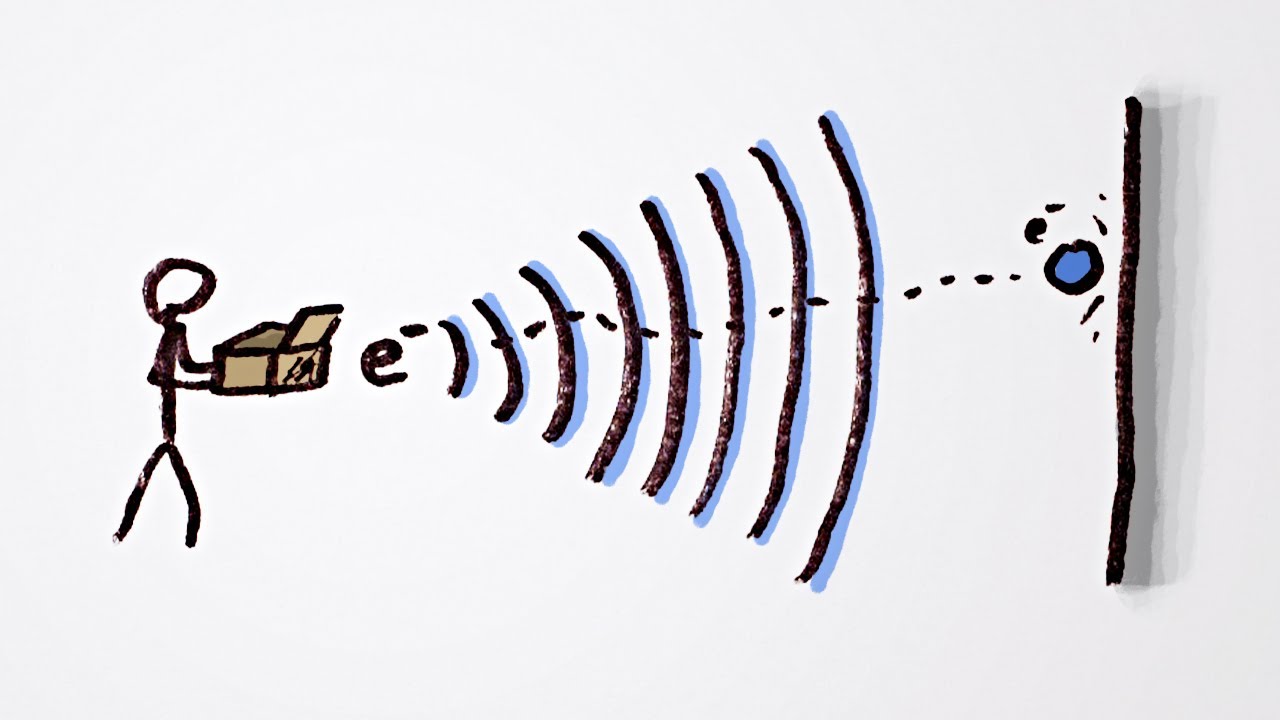
Initially, the light was a particle in the corpuscular model which later is accepted as a wave. However, other matters and radiation possess the dual nature of a particle and a wave. A particle is characterized by its position, size, mass, velocity, momentum, etc. and its motion is described by Newton’s laws of motion. While a wave is characterized by properties such as periodicity in space-time, wavelength, frequency, amplitude, wave velocity, etc., possessing only energy and unlike a particle that localized, wave extends in space. The dual nature of radiation and matter will state the laws of photoelectric emission, that is, no electrons are emitted from metals when the electrons have possessed enough energy greater than the minimum energy to escape the metal surface. Zinc and magnesium will emit electrons only with short-wavelength ultraviolet light while alkali metals will respond even to visible light. The maximum kinetic energy of photoelectrons varies linearly with the frequency of incident radiation and is independent of its intensity. Louis Victor de Broglie reasoned that nature is symmetrical, and that matter and energy must have symmetrical character. If radiation shows dual nature, so will matter be too. He proposed a relation that the wavelength λ associated with a particle momentum p is given by
Where m is the mass of the particle, v is its speed, and h = 6.63 x 10⁻³⁴ J s
The duality of a matter is evident in the de Broglie equation whereλ is the attribute of a wave while momentum p is an attribute of a particle. Planck’s constant h relates the two attributes.
